Build an emergency handoff card that works under stress.
When a helper, driver, shelter worker or responder needs to understand your household’s access and functional needs, a labeled bag is not enough. Put the essential instructions on one readable page, then test whether another person can use it.
Why add a handoff card?
Many emergency lists name supplies but leave the operating knowledge in one person’s head. That knowledge can disappear when a caregiver is delayed, a phone battery dies or a household splits between vehicles. FEMA’s caregiver preparedness guide recommends recording communication preferences, care-team contacts, backup transportation, assistive-technology serial numbers, charging options and other individualized needs. Ready.gov also advises planning for daily needs, transportation and backup power with a personal support network.
The goal is a short bridge between the person and someone who is trying to help. It should answer the questions that change what happens in the next few minutes: How do we communicate? What must travel with us? What cannot be separated from the person? Which device needs power? Who is the backup contact? Where are we trying to go?
Keep detailed insurance, financial and medical records in a protected document module. The handoff card points to that material without turning a visible page into a complete identity file.
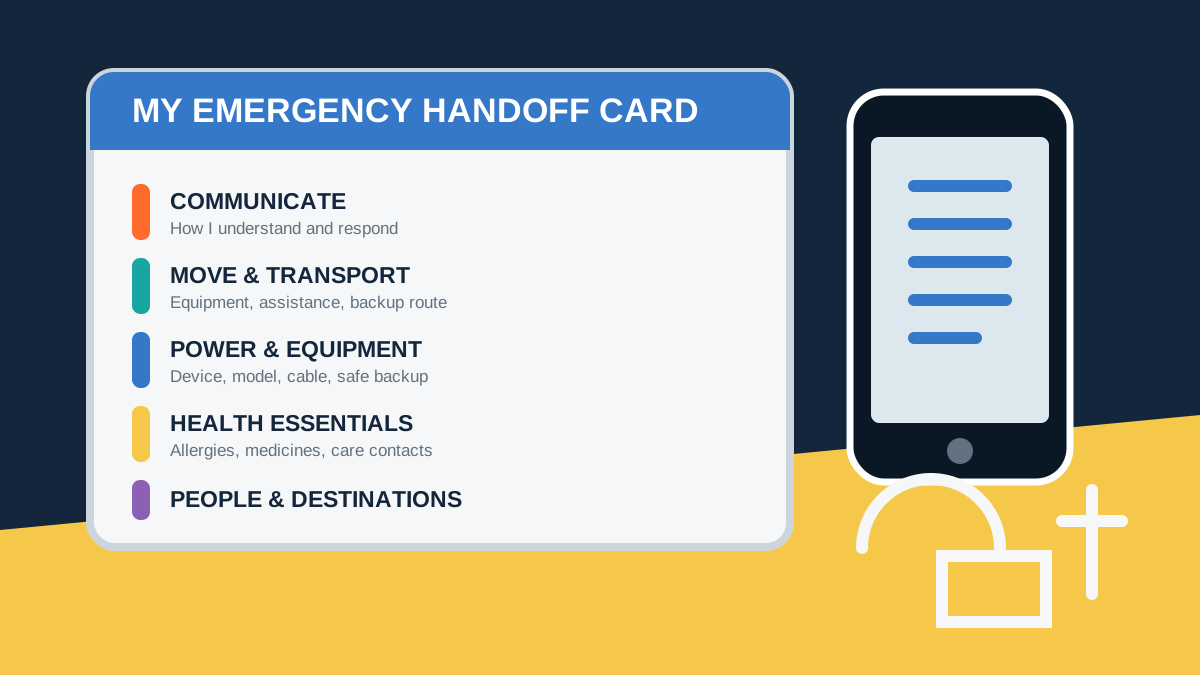
Use five blocks, in priority order
Preferred language and method, yes/no signal, reading format, device used, and what helps when information arrives quickly.
Assistance requested, transfer instructions supplied by the person or clinician, mobility-device details, accessible vehicle needs, and backup pickup.
Essential device, make and model, labeled cable, battery runtime, approved backup method, supplier, and where instructions are stored.
Critical allergies, immediate safety concerns, medicine-list location, refrigeration note, clinician or pharmacy contacts, and service-animal needs.
Two support contacts, accessible transportation, planned destination, alternate destination, meeting point, and current update date.
Write for a hurried reader
A dense biography will not work at a curb, reception desk or shelter entrance. Put urgent actions first. Use direct language such as “I communicate best by text,” “Keep this device with me,” or “My chair requires a lift-equipped vehicle.” Avoid unexplained abbreviations. If a procedure could injure the person or damage equipment, point to the manufacturer’s or clinician’s instructions instead of compressing a complex procedure into a slogan.
- Use large, high-contrast type. A printed copy should remain readable in dim light. Prepare large print, audio, electronic text or another format the person can use.
- Label both sides. Put the person’s preferred name and “Emergency handoff information” on the front. Put the last review date where it is easy to see.
- Describe the normal communication method. The Justice Department notes that effective communication depends on context and the person’s usual method. A card can state the preference; it is not a substitute for a qualified aid or service when one is needed.
- Separate instructions from identifiers. Include only what someone needs to act safely. Store full account numbers, government identifiers and original documents elsewhere.
- Use plain location cues. “Blue pouch in front backpack pocket” is more usable than “with supplies.” Match those words to visible labels.
Map every dependency to a backup
For each essential routine, trace the chain that makes it work. A powered communication device may depend on its charger, a compatible outlet, a battery, someone who knows how to connect it and a destination with power. A mobility plan may depend on an elevator, an accessible vehicle, a transfer method and enough time. Record the weakest link and one realistic backup.
| Need | Card should point to | Test before relying on it |
|---|---|---|
| Communication | Preferred method, device, low-tech alternative, language or format | A new helper exchanges one complete message |
| Mobility | Device dimensions, assistance preference, accessible exit and transport contact | The route works with doors, ramps and the planned vehicle |
| Electric equipment | Make/model, power input, approved battery, runtime and supplier | The backup powers the device as instructed |
| Medicine or supplies | List location, storage note, pharmacy or clinician and resupply plan | A backup person finds the correct labeled module |
| Support person | Primary and alternate contacts with roles | Both know the plan and can access their copy |
Do not promise that a battery lasts a certain number of hours unless you have tested the current setup under its real load and recorded the date. Battery condition, device settings and temperature can change performance. Follow the equipment maker’s instructions and keep generators outdoors at a safe distance from openings.
Plan the accessible route, not only the destination
The Department of Justice identifies evacuation transportation, accessible shelters and effective communication as core parts of emergency planning. A household card cannot solve a community access gap, but it can make the request specific. Record whether a lift-equipped vehicle is needed, whether a service animal travels with the person, and which local transport or emergency-management office holds the current public plan.
Ask the local emergency-management office how accessible transportation requests are handled and how shelter accessibility information is announced. If a voluntary, confidential assistance registry exists, learn its purpose, limits and update process. Registration is one layer; it should not be the only evacuation plan.
Trace the route from the room to the pickup point. Check thresholds, locked doors, elevator assumptions, exterior lighting and the space needed to turn or load equipment. The American Red Cross recommends practicing evacuation drills at least twice a year and whenever the plan or home layout changes. A short household drill reveals whether the card, bag and route actually work together.
Protect privacy without making the card useless
A visible card may need a preferred name, communication instructions, urgent allergies, equipment information and support contacts. It usually does not need full bank numbers, passwords, a Social Security number or original identity documents. FEMA’s Emergency Financial First Aid Kit organizes household identification, legal and financial records, medical information and contacts, and recommends safeguarding paper and electronic copies. Use that protected record system for recovery documents.
- Carry a limited card. Include only the information needed for safe communication, movement and immediate support.
- Seal the detailed copy. Put fuller instructions and document copies in a water-resistant sleeve inside the document module.
- Secure the digital copy. Use a method the owner and an authorized backup can actually unlock without exposing passwords on the card.
- Set a replacement rule. Shred or securely destroy outdated copies when contacts, devices, medicines or destinations change.
Run a 12-minute handoff drill
Give the card and kit to a trusted person who did not write them. Do not coach the first attempt. Ask them to locate the communication method, name the accessible pickup plan, find the correct charger, identify where the medicine list is stored and contact the designated backup. The person whose needs are described should judge whether the helper’s actions and language respect their preferences.
Record every pause. Fix the label, wording, container or route that caused it. If the card keeps growing, move background information into the protected detail sheet and keep the immediate actions on page one. Print fresh copies, sync the accessible electronic version and write the new review date.
Review the card after a new device, medicine, caregiver, transport service, phone number, address, evacuation destination or communication preference. Also check it during the household’s six-month kit inspection.
Sources checked
- Ready.gov: Disaster Preparedness Guide for Caregivers
- Ready.gov: People with Disabilities
- U.S. Department of Justice: Emergency Planning and the ADA
- U.S. Department of Justice: ADA Requirements for Effective Communication
- American Red Cross: Inclusive Preparedness Resources
- FEMA: Emergency Financial First Aid Kit
Research reviewed September 28, 2026.