Build the alert, power and communication module together.
A box of hearing-aid batteries is useful, but it is not the whole plan. Test how the person receives warnings, keeps devices working, communicates with unfamiliar responders, and hands off needs when networks or power fail.
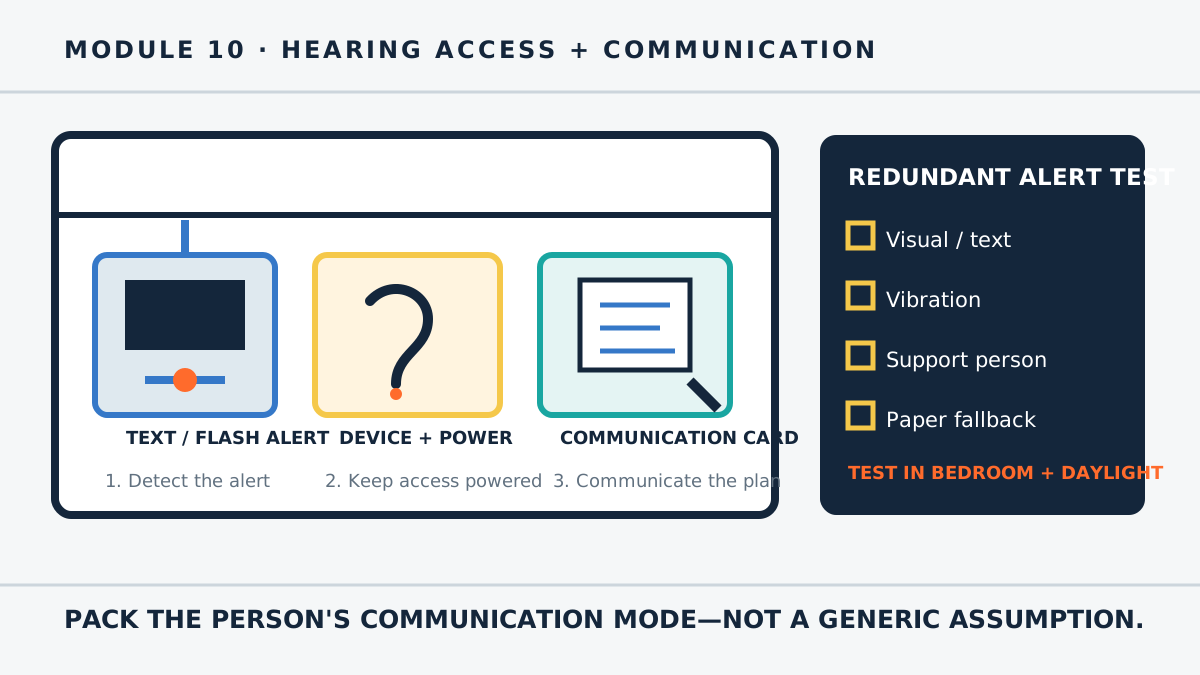
Build three connected layers
Public discussions about emergency hearing access often begin with “How many batteries should I pack?” The deeper questions are whether a sleeping person detects a warning, whether a rechargeable device can be powered during a long outage, and how someone communicates at a shelter, hospital, traffic stop or evacuation checkpoint when their usual technology is unavailable.
CDC tells people with disabilities to customize an emergency kit around everyday needs and includes batteries and portable chargers for adaptive equipment such as hearing aids. FEMA guidance for people who are Deaf or hard of hearing recommends a weather radio with text display and flashing alert, extra hearing-aid batteries, a headlamp, and pen and paper. The National Association of the Deaf emphasizes redundant emergency information across multiple formats because no single alert system reaches everyone reliably.
Visual, vibration, text and support-person alert paths that work awake, asleep, at home and away.
Exact hearing or communication device, approved charger or batteries, cables, dry storage and maintenance dates.
Preferred language and method, paper fallback, interpreters or relay access, key phrases and current contacts.
Who checks in, what responders need to know, where equipment travels and how access is restored.
Start with a one-person access map
Do not start with a shopping list. Sit with the person and document what already works on an ordinary day. Record the preferred language and communication methods, not merely a diagnosis. Note which tools require electricity, cellular service, Wi-Fi, Bluetooth, an account login or a specific charger.
| Situation | Primary access | Offline fallback |
|---|---|---|
| Wake-up warning | Bed shaker, flashing alarm or linked accessibility system | Support-person knock and prearranged entry/check procedure |
| Official alert | Wireless Emergency Alert, local text alert, captioned television | Text-display/flash weather radio and neighborhood check-in |
| Face-to-face exchange | ASL interpreter, spoken communication, captioning or assistive device as preferred | Headlamp, printed card, pen and paper, agreed gestures |
| Remote contact | Text, video relay, real-time text, captioned phone or preferred app | Written contact list and a designated person who can relay logistics |
| Device failure | Backup device, batteries or approved charger | Communication method that does not depend on the device |
A fallback is not automatically equivalent. Writing may not work for someone whose primary language is ASL, for a DeafBlind person, in low light, with limited dexterity or during a high-stress medical exchange. Test the plan with the person in the actual modes and environments expected.
Test an alert triangle, not one notification
NAD recommends redundant emergency communication: the same message should arrive in multiple formats. Build at least three paths that do not all depend on the same phone, internet connection or household power.
- Device alert: enable applicable Wireless Emergency Alerts and accessibility settings on the phone. Confirm the user can find saved alerts afterward.
- Local alert: enroll in county, city, school, utility or campus text and email systems relevant to the person's home, work and travel.
- Independent receiver: consider a battery-powered or hand-crank weather radio with text display and flashing alert, following FEMA guidance and exact product coverage.
- Human check: choose a support person who knows when to text, visit or meet, how to enter safely if invited, and when to escalate.
Run tests in daylight, darkness, sleep conditions and a noisy room. Check whether the warning is visible from the usual chair or bed and whether vibration can be felt where the device is actually kept. Test without creating false public emergency calls. Use built-in test functions and scheduled official alert tests when available.
If two paths share the same phone, charger and cellular network, they are not fully independent. Add a different power source, receiver or person.
Build the hearing-device power pocket
Record the exact hearing aid, cochlear implant processor, bone-conduction device, remote microphone, captioning tablet or other equipment used. Photograph model and charger labels. Keep current manufacturer instructions and the audiologist, implant center or authorized provider contact. The emergency module should never require a stranger to guess which battery, cable or setting belongs to which device.
For disposable-battery equipment, pack the correct size in original or manufacturer-recommended packaging, protected from moisture and metal objects. Rotate by the package date and normal use pattern. Do not let loose batteries contact coins, keys or each other. Follow manufacturer disposal and child-safety instructions; small button batteries can cause severe injury if swallowed.
For rechargeable equipment, confirm the exact approved charger, cable, input and charging conditions. Test whether the charger actually works from the chosen power bank or other backup; physical plug fit is not proof of compatibility. Record how many complete charges the verified setup provides while keeping a conservative reserve.
USFA battery guidance says lithium-ion batteries should be stored at room temperature when possible, kept out of hot cars and away from combustibles, and removed from use if they develop odor, excess heat, swelling, leaking, color change or unusual noise. Do not charge damaged or flood-exposed equipment. Use current manufacturer and fire-safety guidance.
Pack light for face-to-face communication
FEMA recommends a headlamp to illuminate the person you are communicating with. It keeps both hands free for signing, writing, equipment and mobility. Choose a controllable beam that does not shine into someone's eyes, pack spare power, and practice positioning it so faces and hands are visible without glare.
Add a small writing board or weather-resistant paper with high-contrast pens, but treat it as one tool rather than a universal solution. Include a printed card that states the person's chosen communication methods in plain language. It may say, for example, “I am Deaf. Face me. I use ASL. Arrange a qualified interpreter. Text this contact for logistics.” The exact wording belongs to the person.
Do not put a detailed medical history, home access code or unnecessary identity information on the outside of the kit. The emergency document module separates working copies, protected originals and encrypted backups.
Print a communication access card
Name used: ____________________________________
Preferred language: ______________________________
Best communication method: _______________________
Please do: _____________________________________
Please do not: _________________________________
Interpreter / relay / captioning need: ____________
Device or power need: ____________________________
Support contact: _________________________________
Meeting place: __________________________________
Updated: ______________ Next test: ______________
Make copies for the wallet, go-bag and trusted support person. Review the wording directly with the user. Print large enough to read in poor conditions and add tactile identification or an accessible digital copy when useful.
Prepare for shelters and unfamiliar responders
Accessible emergency communication is a responsibility of emergency programs, not a favor. Still, documenting preferences can reduce delay when systems are strained. NAD notes recurring gaps in qualified interpreters, signage and working assistive technology at disaster recovery sites. Ask local emergency management how people request interpreters, captioning, assistive listening or other auxiliary aids before an event.
Keep contacts for the local non-emergency emergency-management office and relevant disability organizations. Know the preferred way to reach 911 in the jurisdiction; text-to-911 availability and procedures vary, so verify locally rather than assuming. In an immediate emergency, use any available accessible method and provide the location first.
A support person can help carry equipment and preserve information, but should not replace a qualified interpreter for complex, medical, legal or high-stakes communication. The user remains the decision-maker whenever possible.
Link power, medication and transport without overloading the bag
The hearing-access module should be easy to grab and easy to hand off. Pair it with the medication module when medicines, clinical contacts or device care overlap. Use the two-zone vehicle guide to keep temperature-sensitive devices and batteries in the carried zone rather than storing them in a hot or freezing car.
Weigh the complete carried kit. A backup that is too heavy, buried under household gear or dependent on one caregiver is not reliable. Assign who carries each module and practice the route with normal mobility aids, service animals, children and winter clothing.
Run a 20-minute access drill
- Send a test message through each enrolled local alert channel.
- Use the weather radio's permitted test function and confirm text/flash visibility.
- Move from the sleeping area to the exit using the actual wake-up alert and lighting plan.
- Switch the hearing or communication device to its verified backup power path.
- Exchange the access card with a person who has not seen it and ask what action they understand.
- Make one offline communication exchange using the planned fallback.
- Grab the module, travel to the meeting point and complete the support-person check-in.
- Record missed alerts, dead batteries, confusing wording, inaccessible doors and carry problems.
Repeat after a device, phone, app, charger, contact, address, job site or evacuation route changes. Also repeat if a test shows that a person sleeps through an alert or cannot see it from the expected position.
Maintain four dates
| Date | What it proves |
|---|---|
| Alert test | Every visual, vibration, text and human path still reaches the person |
| Power test | Exact batteries, charger, cable and backup source still operate the exact device |
| Contact review | Support people, interpreter/relay preferences and local alert enrollment are current |
| Carry drill | The module can be found, lifted, transported and used at the destination |
Use the six-month kit check for the household schedule, but shorten the clock whenever device batteries, charging instructions, alert settings or support contacts change.
Frequently asked questions
Is a phone enough for emergency alerts?
No single device or network is enough. Use multiple paths such as mobile alerts, local text/email enrollment, a text-display/flash weather radio and a support-person plan.
How many hearing-aid batteries should the kit hold?
Base the amount on verified normal consumption, the household's planning period, package and device instructions, storage conditions, rotation dates and resupply plan. Do not copy a generic number that ignores the device and user.
Should the card say “hearing impaired”?
Use the person's chosen identity and exact communication request. Many people prefer Deaf or hard of hearing; some use another term. Functional instructions—such as “face me,” “use ASL,” or “write in large print”—are more useful than an imposed label.
Can I leave backup devices or batteries in the car?
Only if the exact manufacturer storage limits and conditions allow it. Vehicle heat and freezing can damage equipment and reduce battery performance; temperature-sensitive items usually belong in the carried module.
Sources checked
- CDC — Building an Emergency Kit for People with Disabilities
- CDC — Power Sources
- FEMA — Preparedness Inspires Resilience for People with Disabilities
- FEMA — Hurricane Preparedness for People with Disabilities
- National Association of the Deaf — Emergencies and Disasters
- National Association of the Deaf — Accessible Emergency Management Position Statement
- U.S. Fire Administration — Battery Fire Safety
Research reviewed November 4, 2026. Follow current device instructions, the person's communication preferences, and local emergency-management procedures.