If the go bag cannot travel, it is storage.
Weigh the complete load, add the water and last-minute module, fit the carrier over real clothing, then test the first stairs, doorway and safe walking loop. The result is not a heroic distance. It is a clear carry limit, a lighter priority list, and a backup transport plan.
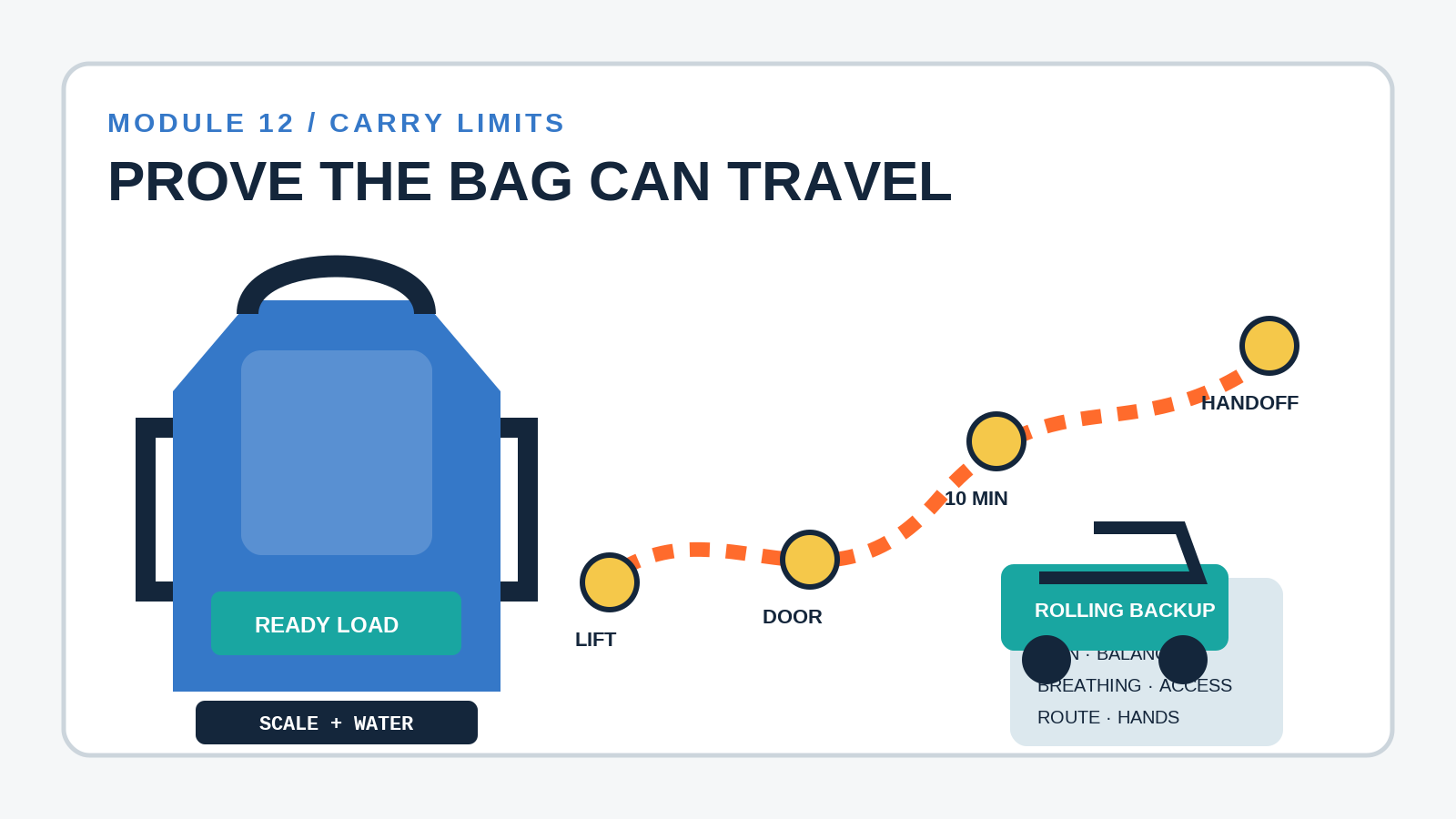
Portability is a requirement, not a label
Ready.gov and the American Red Cross both describe evacuation supplies as easy to carry. CDC's 2025 teen emergency-kit guide makes the tradeoff plain: people have to carry their supplies, so they should not pack many heavy things. Yet current public discussions still feature bags weighed without water, clothing or medications and then judged against a borrowed percentage of body weight.
The better question is not “What should a bug-out bag weigh?” It is “Can this person move this exact load through the first realistic barriers while keeping hands, balance, breathing, communication and necessary equipment usable?” The answer changes when the route, temperature, carrier or person changes.
This audit does not train for wilderness escape or encourage a long walk during an evacuation. Follow official instructions and use safe transportation when available. The test starts with the route you are most likely to need: bedroom to exit, apartment to street, parking area to meeting point, or vehicle to shelter entrance.
Weigh the bag that actually leaves
Start with the packed bag, not a spreadsheet. Put it on a scale with the normal container, pouches and straps. Then add every item normally inserted at departure: filled water bottles, medication module, phone and cable, weather layer, document pouch, child supplies, pet gear and the specific mobility or communication equipment that travels.
Record both the base weight and ready-to-leave weight. Water is often the largest late addition. Do not reduce safe water planning merely to hit a target number; instead, separate home reserves, carried water, vehicle water and a destination resupply plan. The Red Cross distinguishes a three-day evacuation supply from a larger home supply, which is a strong reason not to force every household resource onto one person's back.
| Weight line | What it exposes | Decision |
|---|---|---|
| Empty carrier | The cost of the bag, frame, wheels and organizers | Is the container earning its weight and usable by the person? |
| Base modules | Core light, food, first aid, radio, hygiene and tools | Which items duplicate another working module? |
| Water added | The largest common last-minute increase | Who carries it, and what safe refill or vehicle layer exists? |
| Personal needs | Medication, devices, clothing, sensory and dietary supplies | These are priority needs, not optional “luxuries.” |
| Shared load | Pet, child, document and household equipment | Assign one primary carrier and a named backup. |
Do not solve weight by deleting the wrong things
Cut duplication and fantasy tasks before cutting daily needs. Remove tools no one can use, redundant fire starters, oversized packaging, multiple versions of the same function, stale gear and supplies already staged at the destination. Do not casually remove prescribed medication, communication aids, mobility-device equipment, safe water, infant feeding supplies or weather protection to make the scale look better.
Use three labels on every item: person-critical, route-critical or replaceable at destination. Person-critical items stay with the person. Route-critical items are assigned to someone who can actually carry and operate them. Replaceable items can move to the vehicle, home shelter bin, destination cache or shopping list.
Medication, health and access information, communication aid, identification and essential device power.
Water, light, weather layer, navigation, food and supplies needed before the next safe destination.
Bulky water, blankets, repair tools and longer-duration supplies that do not need to be hand-carried.
The larger shelter-in-place reserve. It should not be mistaken for an evacuation bag.
Fit the carrier over real clothing
A comfortable empty backpack can fail over a winter coat. Put on the shoes, outer layer, mobility device, glasses or hearing equipment you would use. Load the heaviest dense items close to the body and prevent hard edges from pressing through the back panel. Tighten both shoulder straps evenly. Use the hip belt or chest strap if the carrier was designed for one, but do not block medical equipment, breathing, controls or quick removal.
OSHA's workplace lifting guidance is not a go-bag limit, but its risk factors are useful: load distance from the body, awkward posture, twisting, grip, lift height, repetition and duration all change the task. Place the bag at a height that avoids a deep floor lift when possible. Test the load before committing, keep it close, turn with the feet rather than twisting, and get help or divide the load when it is awkward.
A wheeled bag may be better than a backpack for one route and worse on stairs, debris, snow or a crowded pickup point. A small cart can preserve carrying capacity but occupy a hand. Test the actual device through the actual doorway, curb and surface.
Run the eight-checkpoint carry test
Choose a safe time, stable weather and a familiar route. Tell another person you are testing. Do not add weight to “train” during the audit, and do not test alone if balance, breathing, pain, falls or health conditions could make the trial unsafe. Ask a healthcare or rehabilitation professional for individualized guidance when needed.
- Lift: pick up the complete load from its stored position without jerking, twisting or blocking an assistive device.
- Door: unlock, open and close the exit while keeping balance and needed hands available.
- Stairs or threshold: use only the normal safe route; do not invent a stair carry or transfer.
- First 3 minutes: check strap pressure, breathing, posture, vision, hearing equipment and device control.
- Ten minutes: stop at a safe point and record pain, numbness, shortness of breath, dizziness, rubbing, overheating and load shift.
- Turn and sit: verify that the person can turn, use a restroom, sit, stand and remove the carrier without falling or trapping tubing or clothing.
- Communication: reach the phone, alert tool, ID and medication without unloading the bag into the path.
- Return: repeat the entrance, store the carrier and record what failed before moving any item.
The first test can be 10 to 15 minutes. Extend only when the shorter route is comfortable and the likely plan actually requires more walking. Distance is not the goal. The goal is to find the first failure while it is still easy to fix.
Write observable stop rules
“Too heavy” is vague. A stop rule tells the group when to change the plan: new pain, numbness, dizziness, breathing difficulty, unsteady walking, a forward lean, strap marks that persist, inability to use a cane or rail, loss of wheelchair control, repeated need to set the bag down, or inability to manage a door and communicate.
Do not encourage someone to push through symptoms during an evacuation drill. Reduce the load, change the carrier, use wheels, move shared modules, shorten the hand-carry segment or arrange transport. If symptoms are severe or concerning, seek appropriate medical help.
A bag fails when it prevents the person from moving safely, using essential equipment, caring for a dependent, communicating or reaching the planned destination—even if its weight is below a popular percentage.
Make the plan work if one person carries nothing
Injuries, illness, fatigue, a frightened child or a pet carrier can erase expected carrying capacity. Run a second packing round with one adult unavailable and each child carrying zero. Person-critical items remain attached to or beside the person; shared modules receive new owners.
For a household with mobility or disability-related needs, CDC recommends an individual plan, support network, accessible transportation options and practice. The correct answer may be a carried personal pouch plus a rolling shared bag, vehicle bin and named helper—not an enormous backpack. Link the carry test to the mobility-device evacuation module and emergency handoff card.
If a medical device or its power supply travels, do not separate components merely to reduce one bag's number. Use the exact-device outage plan to record compatible power, alarms and relocation triggers.
Children need a child-specific limit
A child's bag is not a miniature adult go bag. The American Academy of Pediatrics advises that a school backpack stay below 15 percent of a child's body weight, fit close to the body with two straps, and be lightened if the child leans forward. That school guidance is a ceiling for that context, not an evacuation target. Emergency stress, weather, distance and other responsibilities argue for keeping the child load lighter and simpler.
A child might carry a comfort item, water bottle, identification card, light layer and whistle appropriate to their age and plan. Adults should retain responsibility for essential medication, household water, documents, first aid and safety equipment. Recheck the bag as clothing sizes, strength, health and understanding change. The plan must still work if the child drops or abandons the bag.
Test the handoff, not only the harness
Label every removable module with its owner, purpose and primary carrier. Practice transferring the shared bag to the backup person without losing medication, documents or a pet leash. If a rideshare, neighbor, paratransit service or shelter transport is part of the plan, confirm bag dimensions and how the carrier, mobility device, service animal and people fit together.
Keep the first-minute items reachable: keys, phone, wallet, current medication, glasses, hearing equipment, alert card and leash. An evacuation bag that must be unpacked across a hallway to find keys has failed navigation, even if it is light.
Go-bag carry audit
Person / carrier
Route / weather layer
Base weight
Ready-to-leave weight
Water added
Last-minute module
- Lift from storage without twisting or blocking equipment.
- Clear the door, threshold and normal stairs or ramp.
- Walk 10 minutes on a familiar safe route.
- Reach phone, ID, medication and light without unloading.
- Sit, stand, turn and remove the carrier safely.
- Repeat with one expected carrier unavailable.
First failure
Observed stop rule
Item moved / removed
Backup transport
Repack by decisions, not fear
| If the test fails here | Change this | Retest |
|---|---|---|
| Floor lift | Raise storage height, split the load or assign help | Lift from the real storage point |
| Door or stairs | Free a hand, change the carrier or route | Use the exact exit with normal clothing |
| Ten-minute walk | Reduce, redistribute, add wheels or shorten hand carry | Repeat without increasing distance |
| Medication or phone access | Move first-minute items to an accessible pouch | Retrieve while standing and seated |
| Caregiver unavailable | Reassign shared modules and transport | Run the missing-person scenario |
| Season change | Add the actual layer, water and traction needs | Repeat in representative conditions |
Record the date beside the six-month kit check, but retest sooner after injury, pregnancy, surgery, illness, a growth spurt, medication or equipment change, new pet, new address, route change or a different carrier.
Frequently asked questions
How heavy should a go bag be?
No universal adult percentage proves it is safe or useful. Test the complete load against the person, carrier, route, weather, responsibilities and transport plan. Stop at pain, instability, altered walking or lost function.
Should water count in the bag weight?
Yes. Weigh the ready-to-leave setup, including water and every last-minute module. Separate carried, vehicle, home and destination water rather than pretending a dry display bag is complete.
What if I cannot carry a backpack?
Use a method that fits the person and route: rolling bag, small cart, vehicle staging, support-person handoff or accessible transport. Keep critical personal items with the person and assign shared supplies by name.
Should everyone carry duplicate gear?
Each person may need essential light, identification, communication and personal needs, but not every shared tool must be duplicated. Assign shared modules and a backup carrier, then test the household with one expected carrier unavailable.
Sources checked
- Ready.gov — Emergency Supply Kit Checklist
- American Red Cross — Survival Kit Supplies
- CDC — Build Your Own Emergency Kit
- CDC — Making an Emergency Plan
- OSHA — Safe-weight factors for manual lifting
- American Academy of Pediatrics — Backpack Safety
Research reviewed November 16, 2026. Follow official evacuation instructions, individual healthcare guidance, carrier limits and the person's access needs. Public discussions were used to identify recurring questions about missing water weight, percentage rules, overpacked tools and untested bags; recommendations above come from the cited public-safety, health and ergonomics sources.